Your Business Has a Brand. You Have an Identity.

I once wrote an entire article about why I hated using colour psychology to choose business colours. I still stand by the basic argument.
We have been taught that blue means trust, red means energy, green means growth and so on. There is research behind the way colour can influence us, but human perception is far messier than a colour chart. Culture, memory, context, personal associations and experience all affect what somebody sees and feels.
There was another idea buried in that old article that has become far more important to my work since: your business has a brand identity, but you are a human being with a public identity. Those two things can influence each other without becoming the same thing.
Recognition comes from repetition
Think about Starbucks green. You can recognise the company from that particular green because you have encountered it repeatedly alongside the logo, stores, cups and other visual signals. If Starbucks suddenly changed to an unfamiliar lime green, you would probably notice immediately.
That is recognition at work. A signal repeats often enough that your brain starts connecting it with a particular source.
The same thing happens with people, except the evidence is much richer. People notice colours and clothes, but they also notice the subjects you repeatedly discuss, the language you use, the stories you tell, the way you respond to questions, what makes you laugh, where you become animated and the things you consistently avoid.
Eventually those signals accumulate into an impression of you.
You are not your company’s mascot
One line from my original 2022 article still makes me smile: consider yourself a brand ambassador for your business, not a walking mascot for it.
I meant it literally at the time. I was doing image consulting and explaining why somebody did not need to dress head-to-toe in their company colours simply because they were the face of the business.
Today I would take the idea much further.
Your company can have a logo, fonts, colours, packaging and a carefully designed visual system. A person cannot be reduced to a matching set of brand assets. People encounter your temperament, humour, experience, contradictions, habits, values, confidence, uncertainty and hundreds of other small signals that no brand guideline could completely control.
Trying too hard to make the person perfectly match the business can actually flatten some of the characteristics that make the person memorable.
Boss Diplomat yellow survived. I changed.
Yellow has been part of Boss Diplomat for years. I originally chose it because I loved the energy of it. Ironically, yellow is also a terrible clothing colour on me.
I learned through colour analysis that I sit within a dark winter palette, so the colours that tend to work best against my own colouring are very different from the yellow associated with my business.
That never created a problem. Boss Diplomat could wear yellow without Talyn having to.
Years later, my work, public identity and visual language have evolved enormously. Yellow still appears in my world, including in details such as my boxing wraps, but it is one signal among many. It does not need to turn me into a human version of a company logo.
People are reading more than your colours
This is where the distinction between branding and public identity becomes useful.
A business brand is deliberately constructed. You can choose its logo, palette, typography and marketing language.
Your public identity develops through what other people repeatedly encounter from you. Some of those signals are intentional. Others escape without you realising they are saying anything at all.
Someone may remember your bright blazer. They may also remember the oddly specific phrase you use every time you explain your work, the question you always ask, the subject that makes you come alive, the way you challenge an assumption or the story you casually tell that reveals far more about you than the polished bio on your website.
Those signals are why two people wearing almost identical clothes can leave completely different impressions.
Look beyond the palette
If you are the visible face of a business, look at your company and then look at yourself.
Where do the two naturally overlap? Which parts of the business genuinely feel like an extension of you? Which things exist because they belong to the company rather than to you personally? And if somebody removed the logo, colours and carefully designed graphics, what would still make them recognise you?
That last question is the one I find most interesting.
Because your public identity is being built from far more than the colours you chose in Canva. It is being built from the clues you leave everywhere.
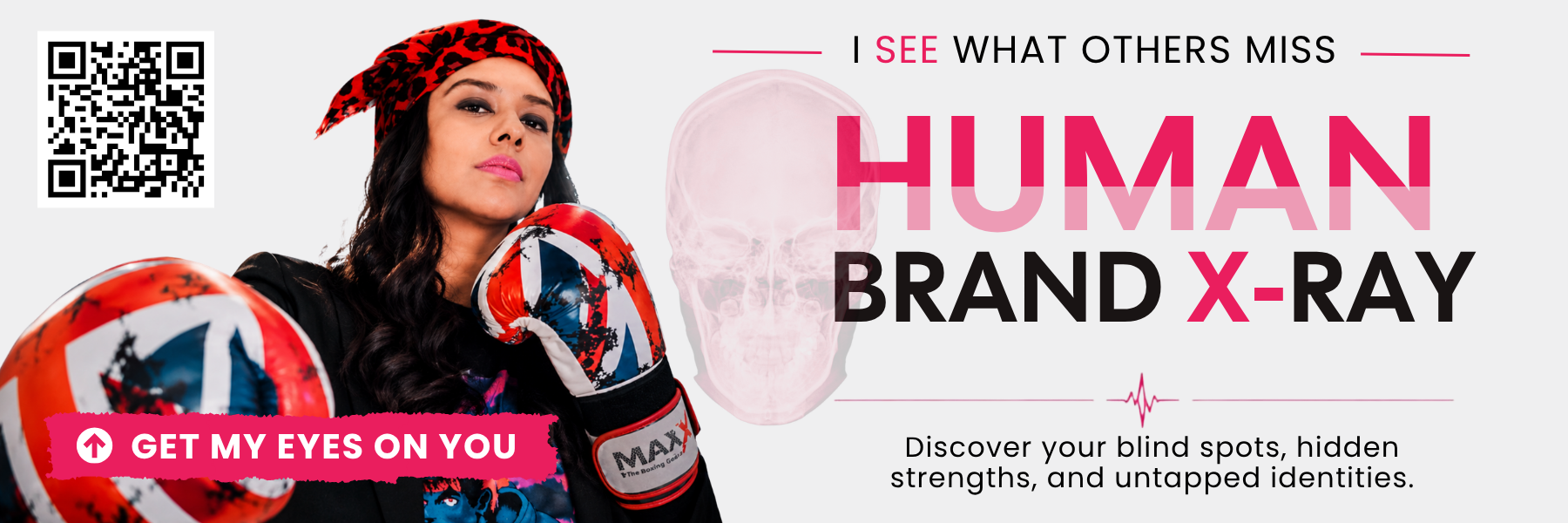
And sometimes somebody looking from the outside can see those clues much more clearly than you can.